
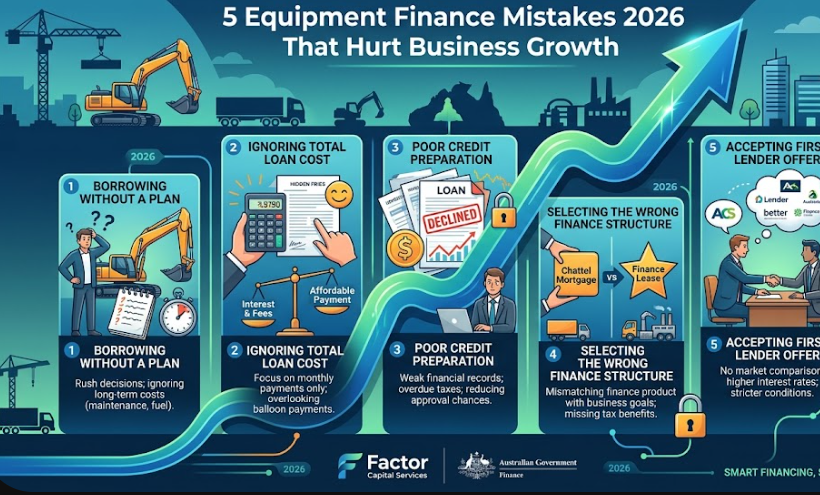
Avoid the top 5 Equipment Finance Mistakes 2026 . Learn smart financing strategies, reduce loan costs, and grow your Australian business with confidence.
5 Equipment Finance Mistakes 2026
Equipment finance is becoming more important for Australian businesses in 2026. Companies across transport, construction, healthcare, agriculture, and manufacturing are using finance solutions to purchase vehicles, machinery, and commercial equipment without affecting cash flow. However, many businesses still make costly borrowing mistakes that increase expenses and reduce long-term profitability. Understanding the biggest financing problems can help business owners make smarter decisions and secure better loan terms.
The keyword 5 Equipment Finance Mistakes 2026 highlights the growing need for businesses to avoid poor finance strategies in a changing economy. Rising interest rates, inflation pressures, and stricter lending conditions mean businesses must carefully plan every finance decision. A small mistake in a finance agreement can lead to years of unnecessary repayments and financial pressure.
Businesses looking for professional funding support can explore finance options through Factor Capital Services. For official financial guidance and government business resources, businesses can also visit Australian Government Finance.
5 Equipment Finance Mistakes 2026 Businesses Must Avoid
The first issue connected with 5 Equipment Finance Mistakes 2026 is borrowing without proper business planning. Many companies rush into finance agreements because they want immediate access to new equipment. While upgrading machinery or vehicles may improve operations, businesses often fail to calculate the long-term financial impact of repayments, maintenance costs, fuel expenses, and insurance requirements. This creates cash flow problems later and increases financial stress.
Businesses should always evaluate whether financed equipment will generate higher revenue or improve productivity before signing a finance contract. A finance solution should support growth, not create unnecessary debt obligations that reduce profitability.
Another major concern related to 5 Equipment Finance Mistakes 2026 is ignoring the total loan cost. Many business owners focus only on monthly repayment amounts instead of reviewing interest rates, hidden fees, and final balloon payments. Some finance agreements may appear affordable at first but become expensive over time because of additional charges and long repayment periods.
Understanding the complete borrowing cost is essential before accepting any commercial finance offer. Comparing multiple lenders and reviewing contract terms carefully can help businesses avoid overpaying on equipment loans.
The third problem in 5 Equipment Finance Mistakes 2026 involves poor credit preparation before applying for finance. In 2026, Australian lenders are reviewing business financial records more carefully because economic uncertainty continues to affect lending conditions. Businesses with inconsistent cash flow, overdue tax obligations, or weak financial records may face higher interest rates or loan rejections.
Preparing updated bank statements, improving cash flow management, and reducing unnecessary liabilities can improve approval chances significantly. Businesses that maintain strong financial records often receive more flexible repayment terms and lower borrowing costs.
Another issue connected with 5 Equipment Finance Mistakes 2026 is selecting the wrong finance structure. Different business finance options serve different purposes. Some businesses may benefit from chattel mortgages, while others require finance leases or low-doc funding depending on their financial structure and operational goals.
Choosing the wrong finance product can increase tax complications and repayment pressure. Businesses should carefully analyse repayment flexibility, ownership conditions, and tax benefits before selecting a finance solution.
The final challenge in 5 Equipment Finance Mistakes 2026 is accepting the first lender offer without comparison. Many businesses fail to research alternative lenders and financing providers. This often results in higher interest rates and stricter repayment conditions that could have been avoided with proper market comparison.
Working with experienced finance specialists can help businesses access better loan structures and competitive lending options. A broader lender network often increases approval opportunities and improves borrowing flexibility.
Why Equipment Finance Is Critical in 2026
The topic 5 Equipment Finance Mistakes 2026 is becoming increasingly important because Australian businesses are operating in a highly competitive environment. Companies need modern equipment and updated technology to remain productive and profitable. Equipment finance allows businesses to preserve working capital while still investing in essential assets.
Instead of paying large upfront costs, businesses can spread repayments over manageable periods. This improves cash flow and allows companies to allocate funds toward staffing, marketing, and operational growth. Equipment finance has become a strategic business tool rather than simply a borrowing solution.
Many industries are also experiencing rising operational expenses in 2026. Fuel costs, labour shortages, and supply chain disruptions continue to impact business performance across Australia. Financing equipment helps businesses reduce immediate financial pressure while maintaining operational efficiency.
Businesses that understand 5 Equipment Finance Mistakes 2026 can position themselves more effectively in the market. Smart finance decisions help companies reduce risk, improve profitability, and maintain stronger financial stability during economic uncertainty.
How Businesses Can Improve Finance Decisions
One important lesson from 5 Equipment Finance Mistakes 2026 is the need for detailed financial preparation before applying for funding. Businesses should review their revenue forecasts, operational expenses, and repayment capacity before selecting any finance solution.
Clear financial planning improves lender confidence and increases approval chances. Businesses should also maintain accurate accounting records and ensure tax obligations are managed properly before submitting applications.
Another strategy related to 5 Equipment Finance Mistakes 2026 is understanding the return on investment from financed equipment. Equipment should improve productivity, increase revenue, or reduce operational downtime. Borrowing for equipment that does not generate measurable business value can negatively affect long-term profitability.
Businesses should also communicate openly with lenders during the approval process. Providing accurate financial information and supporting documentation can speed up approvals and improve loan conditions. Transparency remains one of the most important factors in commercial finance approvals.
Professional finance guidance can also help businesses avoid the problems highlighted in 5 Equipment Finance Mistakes 2026. Finance specialists understand lender requirements, industry risks, and commercial borrowing trends. This expertise allows businesses to secure more suitable finance structures and reduce long-term costs.
The Future of Equipment Finance in Australia
The discussion around 5 Equipment Finance Mistakes 2026 is expected to grow as Australian businesses continue investing in automation and modern technology. Companies are increasingly adopting advanced machinery, energy-efficient systems, and digital equipment to remain competitive in changing industries.
Sustainability is also becoming a major focus in commercial finance. Many lenders now provide flexible funding for environmentally friendly equipment such as electric vehicles and renewable energy systems. Businesses investing in sustainable technology may gain financial advantages in the future.
Digital lending platforms are also changing how businesses access finance. Faster online approvals and automated assessments are making equipment finance more accessible for small and medium-sized businesses. However, this also means lenders can review business financial data more efficiently, increasing the importance of strong financial management.
Businesses that understand 5 Equipment Finance Mistakes 2026 will likely perform better financially because they can avoid unnecessary borrowing costs and secure more strategic funding solutions.
Common Signs of a Bad Equipment Finance Deal
The keyword 5 Equipment Finance Mistakes 2026 also highlights the importance of recognising warning signs before signing finance agreements. Businesses should carefully review repayment terms, interest structures, hidden charges, and contract flexibility before making commitments.
One warning sign is extremely low introductory repayments that later increase significantly. Some finance agreements may include large balloon payments that create financial pressure at the end of the loan term. Businesses should fully understand future repayment obligations before accepting any offer.
Another issue connected with 5 Equipment Finance Mistakes 2026 is limited repayment flexibility. Businesses operating in seasonal industries may require flexible repayment schedules that match cash flow cycles. Rigid repayment structures can create financial difficulties during slower business periods.
High exit fees and strict refinancing conditions can also create problems. Businesses should review whether early payout options or refinancing opportunities are available within the agreement. Flexibility is increasingly important in modern commercial finance arrangements.
Conclusion
The topic 5 Equipment Finance Mistakes 2026 is highly relevant for Australian businesses seeking smarter funding strategies in a competitive economy. Equipment finance can support growth, improve productivity, and preserve working capital, but poor finance decisions can create long-term financial stress.
Businesses should avoid borrowing without planning, ignoring total loan costs, applying with weak financial preparation, choosing unsuitable finance structures, and accepting lender offers without comparison. These common mistakes often lead to higher repayments, reduced profitability, and cash flow problems.
Understanding 5 Equipment Finance Mistakes 2026 allows businesses to make informed finance decisions that support long-term success. Careful planning, professional guidance, and proper lender comparison can help businesses secure better loan terms while protecting financial stability.
As the Australian business landscape continues evolving, smart equipment finance strategies will remain essential for companies looking to grow efficiently and remain competitive throughout 2026 and beyond.
