
Discover 7 proven SME finance strategies for Australian businesses in 2026. Learn how to improve cash flow, secure funding, and grow your SME successfully.
7 Proven SME Finance Strategies
Small and medium-sized enterprises are the foundation of the Australian economy. SMEs contribute significantly to employment, innovation, and economic growth across industries such as retail, transport, construction, healthcare, and professional services. However, many business owners struggle with funding challenges, cash flow management, and rising operational costs. Strong financial planning has become essential for businesses looking to remain competitive in 2026.
The keyword 7 proven SME finance strategies is becoming increasingly important because modern businesses require smarter financial management to survive in a changing economic environment. Rising inflation, stricter lending conditions, and increasing business expenses mean SMEs must develop efficient funding and cash flow strategies to support sustainable growth.
Businesses seeking professional commercial finance support can explore funding options through Factor Capital Services. Australian business owners can also review official financial resources and economic information through Australian Government Finance.
7 Proven SME Finance Strategies
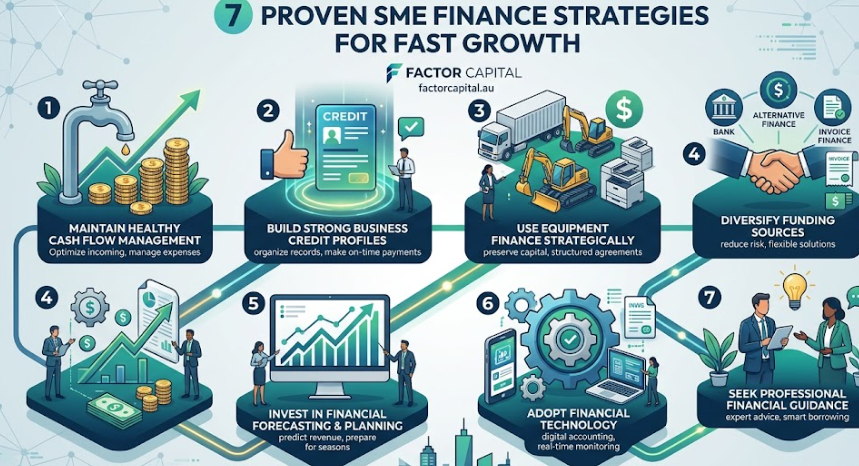
The topic 7 proven SME finance strategies begins with one of the most important business principles, which is maintaining healthy cash flow management. Many SMEs focus heavily on revenue generation while overlooking cash flow stability. Even profitable businesses can face financial difficulties if expenses exceed available working capital.
Effective cash flow planning helps businesses manage supplier payments, wages, operational costs, and loan repayments more efficiently. SMEs that monitor income and expenses consistently are more likely to avoid financial pressure during slower trading periods.
Another important point connected with 7 proven SME finance strategies is building strong business credit profiles. In 2026, Australian lenders are reviewing business financial health more carefully before approving loans or commercial finance applications. Businesses with consistent payment histories and organised financial records usually receive better lending opportunities.
Improving credit strength can reduce borrowing costs and increase access to flexible finance solutions. Businesses should avoid overdue payments, manage liabilities responsibly, and maintain updated financial documentation to improve lender confidence.
The third strategy related to 7 proven SME finance strategies involves using equipment finance strategically. Many SMEs require vehicles, machinery, and operational equipment to maintain productivity and support expansion. Instead of paying large upfront costs, businesses can preserve cash flow through structured finance agreements.
Smart equipment financing allows SMEs to invest in growth without draining working capital reserves. However, businesses should ensure finance repayments remain aligned with long-term revenue expectations to avoid unnecessary financial strain.
Another essential lesson associated with 7 proven SME finance strategies is diversifying funding sources. Many SMEs rely entirely on traditional bank loans, which may not always provide flexible approval conditions. Alternative lenders, invoice finance providers, and commercial finance specialists are becoming increasingly important within Australia’s lending market.
Businesses that explore multiple funding solutions often improve borrowing flexibility and reduce financial risk. Access to different finance options can help SMEs respond faster to growth opportunities and unexpected operational challenges.
The fifth point linked with 7 proven SME finance strategies is investing in financial forecasting and planning. Businesses that analyse future revenue trends and operational expenses are more likely to make informed financial decisions.
Forecasting helps SMEs prepare for seasonal demand fluctuations, rising operational costs, and market changes. Accurate financial projections also improve lender confidence during loan applications because they demonstrate long-term planning and financial awareness.
Technology adoption is another major factor connected with 7 proven SME finance strategies. Digital accounting systems, automated invoicing platforms, and financial management software help businesses improve operational efficiency and reduce administrative costs.
Modern financial technology allows SMEs to monitor cash flow in real time and identify potential financial problems earlier. Businesses that adopt digital financial tools often improve budgeting accuracy and operational productivity.
The final strategy related to 7 proven SME finance strategies involves seeking professional financial guidance when making major borrowing or investment decisions. Commercial finance specialists understand lender requirements, market conditions, and business funding structures. Their expertise can help SMEs secure more suitable finance solutions while reducing unnecessary financial risks.
Professional advice is especially valuable during periods of economic uncertainty when businesses must manage rising costs and changing lending conditions carefully.
Why SME Finance Strategies Matter in 2026
The importance of 7 proven SME finance strategies continues increasing because Australian businesses are operating in a highly competitive and rapidly changing environment. Rising inflation, supply chain disruptions, labour shortages, and interest rate pressures are affecting businesses across multiple industries.
SMEs must now focus more heavily on financial efficiency and long-term stability rather than short-term growth alone. Businesses that fail to manage finances strategically may struggle with cash flow problems, limited funding access, and operational instability.
Strong finance strategies help businesses maintain flexibility during uncertain market conditions. Access to funding allows SMEs to invest in staffing, technology, equipment, and expansion opportunities while protecting working capital reserves.
Another reason why 7 proven SME finance strategies are important is the increasing role of digital transformation within the Australian economy. Businesses adopting advanced technology and automated systems often gain operational advantages over competitors.
Financial planning also helps SMEs prepare for unexpected market changes. Businesses with stable cash reserves and efficient financial management are better positioned to handle economic downturns and operational disruptions.
Common Financial Mistakes SMEs Make
The discussion around 7 proven SME finance strategies also highlights several common financial mistakes that affect small businesses across Australia. One major issue is poor budgeting and inaccurate expense forecasting. Many SMEs underestimate operational costs, which creates financial pressure during slower revenue periods.
Another challenge connected with 7 proven SME finance strategies is relying too heavily on short-term borrowing. Businesses that continuously depend on high-interest funding solutions may experience increasing debt pressure over time.
Some SMEs also fail to review finance agreements carefully before accepting funding offers. Hidden fees, strict repayment conditions, and unsuitable loan structures can affect long-term profitability significantly.
Poor tax planning is another issue related to 7 proven SME finance strategies. Businesses that fail to manage tax obligations properly may experience cash flow disruptions and financial penalties that reduce operational stability.
Ignoring technology investments can also create long-term disadvantages. Businesses using outdated systems often experience lower productivity and higher operational costs compared to competitors adopting modern financial technology.
Understanding these mistakes helps SMEs improve financial management and create stronger long-term growth strategies.
How SMEs Can Improve Financial Stability
One of the strongest lessons from 7 proven SME finance strategies is the importance of maintaining financial discipline. Businesses should regularly review budgets, monitor expenses, and assess operational performance to identify financial risks early.
SMEs should also maintain emergency cash reserves to manage unexpected expenses or economic downturns. Financial flexibility is becoming increasingly valuable in 2026 because business conditions continue evolving rapidly.
Another strategy related to 7 proven SME finance strategies is strengthening customer payment systems. Late customer payments can create serious cash flow problems for small businesses. Automated invoicing systems and clear payment terms can improve revenue consistency and reduce collection delays.
Businesses should also review supplier agreements regularly to negotiate better pricing or payment conditions where possible. Reducing unnecessary operational expenses improves profitability and cash flow management.
Professional accounting support can also strengthen financial decision-making. Experienced financial advisors help SMEs improve tax planning, budgeting, and borrowing strategies while reducing compliance risks.
The Future of SME Finance in Australia
The future of 7 proven SME finance strategies is closely connected with technological innovation and changing commercial lending trends. Digital finance platforms are making funding more accessible for small businesses through faster approvals and simplified applications.
Alternative lending solutions are also becoming more popular because they provide flexible finance structures for businesses that may not meet traditional bank requirements. SMEs now have access to broader funding opportunities than ever before.
Sustainability is another major trend shaping the future of SME finance. Many lenders are supporting environmentally friendly business investments, including renewable energy systems, fuel-efficient equipment, and sustainable operational practices.
Businesses adopting sustainable growth strategies may benefit from improved financing opportunities and stronger market positioning in the future.
The growing use of automation and artificial intelligence within financial systems will also continue improving business efficiency. SMEs that adapt to digital finance technology are likely to gain stronger operational and financial advantages.
Understanding 7 proven SME finance strategies will remain essential for businesses looking to achieve long-term stability and sustainable growth in Australia’s competitive economy.
Conclusion
The topic 7 proven SME finance strategies is highly relevant for Australian businesses seeking stronger financial performance in 2026. Effective finance strategies help SMEs manage cash flow, secure funding, reduce operational risks, and improve long-term profitability.
Businesses should focus on cash flow management, credit improvement, strategic equipment finance, diversified funding sources, financial forecasting, technology adoption, and professional financial guidance. These strategies create stronger operational stability and improve business growth opportunities.
Understanding 7 proven SME finance strategies allows SMEs to make smarter financial decisions while adapting to changing market conditions. Businesses that manage finances strategically are more likely to achieve sustainable growth and maintain competitive advantages.
As Australia’s economy continues evolving, SMEs that invest in strong financial planning and modern funding strategies will remain better positioned for success throughout 2026 and beyond.
